Posts tagged cultural worlds

Nate
:
Nate
:
A French aid worker in Congo, Cabiau admits that he has trouble telling Werrason apart from Wazekwa, but that he’s “developed a taste for this joyous cacaphony.”
Lorsque les décibels s’affolent, impossible de rester assis. Si l’on se donne la peine de s’aventurer sur la piste, au milieu des miroirs et des déhanchements endiablés, on ne peut que succomber. On est alors entraîné dans des chorégraphies délirantes que tout bon kinois connaît sur le bout des doigts. C’est le feu. De la folie furieuse. C’est Kinshasa.
When the decibels reach a panic, it’s impossible to stay seated. If make the effort to get out there on the dance floor, among the mirrors and the frenzy of swaying hips, you cannot help but give in. You are led out into wild dance moves that every good kinois knows at the edge of his fingertips. It’s on fire. It’s madness. It’s Kinshasa.
Cabiau also writes about the phenomenon of “libanga.” Libanga is to Congolese music what product placement is to American film and television. For a few thousand dollars, “a company, a brand of beer, a politicians, or an officer in the army” can see his name placed in a song. Several dozen such paid shoutouts might be in a single song. “Curiously, that doesn’t seem to bother many people,” Cabiau writes.
 My pleasant uninteresting place
Nate
:A Chinese curse condemns one to live in interesting and eventful times. The best thing about Covington is that it is in a certain sense out of place and time but not too far out and therefore just the place for a Chinese scholar who asks nothing more than being left alone. One can sniff the ozone from the pine trees, visit the local bars, eat crawfish, and drink Dixie beer and feel as good as it is possible to feel in this awfully interesting century. And now and then, drive across the lake to New Orleans, still an entrancing city, eat trout amandine at Galatoire’s, drive home to my pleasant, uninteresting place, try to figure out how the world got into such a fix, shrug, take a drink, and listen to the frogs tune up.
 A year of… books
Nate
:
A collection of books, compiled by Rex, by people who spent a year doing something and then wrote a book about it. Topics include competitive eating, not shopping, and reading the OED.
Nate
:In a recent California Supreme Court case (Bernard vs. Foley), the court decided that friends who care for their elderly or infirm counterparts cannot take gifts or bequests without some special proof that they didn’t unduly influence their friends into making the donation. Perversely, if you take care of your friends when they most need you, you may be disqualifying yourself from accepting their largess.
For a while, lower courts found a way around this awkward burden in the case of “pre-existing” friendships, creating a special exemption from the “custodial care provisions” that the Supreme Court recently interpreted. But the Supreme Court simply thought the pre-existing friendship exemption carved by the lower courts could not be justified by the statutory language.
In my work on friendship and the law, I took the modest position that the lower courts had the right instinct — and that it would be a good thing if friends didn’t have to worry about disqualifying themselves from accepting gifts and bequests merely by trying to care for their infirm counterpart. It is good to see that the Commission, after having read my case, is supportive of the Legislature changing the rules.
There’s a lot to say about why we don’t want the law getting too involved in our friendships. But this is a simple way to help protect friends and encourage the care they can provide for one another — and more cheaply than Medicare, to boot.
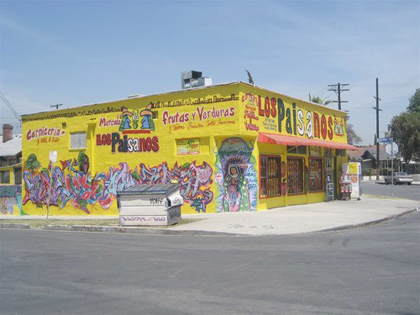
 Taggers abhor a vacuum
Nate
:Your church home on the range
Nate
:At least 600 cowboy churches are scattered across the U.S., according to leaders in the movement and published accounts. In central and southern Illinois, an estimated two dozen congregations meet in barns and arenas, on the dusty trails and in churches—some decorated with Western memorabilia.
Some evangelical Christians have questioned whether the churches only offer gimmicks and fail to provide a meaningful spiritual experience.
But pastors and churchgoers said their services are divinely inspired. Like the suburban megachurches that beckon teenagers with gospel-themed rap and rock music, cowboy sanctuaries promote country-western worship while seeking to attract those who find traditional rural church settings unattractive.
ah-SEE-sh?
Nate
:I’m not going to get into the politics of the mess in the north Caucasus except to say that there are no good guys, but I have to get a minor linguistic gripe off my chest: all the news broadcasts are talking about “ah-SET-ee-?” and the “ah-SET-ee-?nz.” What’s next, cro-AT-ee-?? ve-NET-ee-?n art? I realize none of the broadcasters and reporters have ever heard of Ossetia before, but you’d think the patterns of English spelling would clue them in to its proper pronunciation, ah-SEE-sh?. I suppose it’s another case of hyperforeignification, like “bei-ZHING.”
Incidentally, Ossetian (as every schoolboy knows) is an Iranian language, and the Ossetian name for Ossetia is Iryston, based on Ir, the self-designation meaning ‘an Ossetian’ (well, actually it specifically refers to the majority group of Ossetians, and the minority Digors resent the use of that name for the whole people, causing some Ossetes to identify with the medieval Alans and call Ossetia “Alania,” but let’s set that aside—if you’re interested in the messy politics of Caucasian ethnic nomenclature and the Alans, read “The Politics of a Name: Between Consolidation and Separation in the Northern Caucasus” [pdf, html] by Victor Shnirelman); it used to be thought that Ir was derived from *arya- ‘Aryan’ and thus related to Iran, but Ronald Kim denies this in “On the Historical Phonology of Ossetic: The Origin of the Oblique Case Suffix,” Journal of the American Oriental Society, Vol. 123 (Jan. - Mar. 2003), pp. 43-72 (2.0.CO;2-5”>JSTOR); the relevant discussion is on p. 60, fn. 42. Kim says it may be from a Caucasian language, or it may be descended from PIE *wiro- ‘man.’ (The word Ossetian is based on a Russian borrowing of the Georgian term Oseti.)

Nate
:Abu Ali, Shabbos Goy
Nate
:Like any archaic tradition, getting non-Jews to help on the Sabbath has evolved over time. Talmudic scholars, Jewish academics and Israeli lawmakers all have wrestled with how to balance religious devotion and modern life.
In this Jerusalem neighborhood, once the sun sets on Fridays and the streets are cordoned off, the only driver on the roads is Abu Ali, in his white taxi, with a red police light that he puts on the roof and special laminated signs he sticks in the front window so his car isn’t mistakenly attacked.
Since observant Jews can’t ask for help, they use a special code with Abu Ali. If they need the air conditioner turned on, they tell him that it’s hot. If they need a light turned on or a fuse changed, they say that it’s dark.
Abu Ali charges about $10 per visit. If he has to rush a pregnant woman to the hospital — something he said he sometimes has to do three or for times each Sabbath — it costs about $30.
The families aren’t supposed to pay him for his services, so the community set up a box outside the neighborhood synagogue where people can put the money. If Abu Ali has to come collect directly, it costs an extra $5.
“The food here is awful!”
Nate
:By 5 p.m. Curtis had made his first two purchases: frozen chicken wings and a can of beans ($4.75); a T-shirt and pair of socks from a vendor on the street ($2.00).
Meanwhile, Michael drove his rental car around the neighborhood. When he returned to meet us he was exasperated. “The food here is awful! No fruit, vegetables are moldy. Only meat, canned food, and soda. What do kids eat? The guy at the store told me no one would eat fruit unless it’s in a can. Is that true?”
Curtis shook his head. I told Michael, “When we get back to New York, I will talk with you about diet and quality of food availability in poor neighborhoods.”
But Michael was growing upset. “All I see are liquor stores and dollar stores and fast food. There was one guy who said he’d buy my food stamps — 50 cents for a dollar in stamps? How can people live like this?”
Curtis laughed. He asked Michael if he’d like some chicken and beans. Michael said, “No thank you,” and sat on the cold linoleum floor. He was silent.
“How much does a banana cost,” Curtis asked Michael. Michael looked embarrassed, unable to answer.
“You don’t know, do you!” Curtis laughed. “See fruit is expensive; raw food is too much for low income people. And we don’t always have a fridge, so you got to keep things in cans. That way it can move with you. And one thing you need to know: low income people always are on the move — not just squatters, all low income folks.”
Andy
:The courageous if forlorn career of Dr. Albert Schweitzer . . . is testimony to the reach as well as the gulf of advanced technology and cultural sophistication. The author of the highly influential study, Quest of the Historical Jesus, and the recipient in 1952 of the Nobel Peace Prize, Schweitzer propounded a New Age philosophy of “reverence for life” that took little account of African ideas of God or of the Africans themselves, whom he kept at arm’s length though he lived among them. . . .
The strange controversy that Schweitzer represented happened to be perfectly consistent with the European idea of religion as reason unimpeded by intercultural understanding. Schweitzer did not believe in evangelizing Africans, only in doing good for them and being somewhat indifferent to their homage and gratitude. For him, Africans lacked the capacity for abstraction . . . and it was the duty and mission of Europeans to remedy that cultural inadequacy without requiring Christianity. It was a strange idea for him that Africans could become Christian without being European, or without possessing the European capacity for universal rationalization. . . . In effect, Europe’s high intellectual tradition was not transferable even by proximity, and so the very idea of Christian mission was an oxymoron. On the other hand, colonialism might bestow upon the tribes the benefits of modern science and technology without superstitious religious distractions.
Schweitzer’s lean prescription of religion as reverence for life—free of creed and sacrament—appealed to the modern mind because of its elegance, its clinical brevity, its inclusive simplicity, and its self-direction, but it left him with no obligation to learn from Africans. It is little surprise that Africans could not otherwise claim him, though they respected him and protected him as a stranger among them.
Nate
:Sometimes conversion is gradual, but quite commonly things come to a head in a single instant, which can be triggered by a text, an image, a ceremony or some private realisation. A religious person would call such a moment a summons from God; a psychologist might speak of an instant when the walls between the conscious and unconscious break down, perhaps because an external stimulus—words, a picture, a rite—connects with something very deep inside.
For people of an artistic bent, the catalyst is often a religious image which serves as a window into a new reality. One recurring theme in conversion stories is that cultural forms which are, on the face of it, foreign to the convert somehow feel familiar, like a homecoming. That, the convert feels, “is what I have always believed without being fully aware of it.”
Take Jennie Baker, an ethnic Chinese nurse who moved from Malaysia to England. She was an evangelical, practising but not quite satisfied with a Christianity that eschews aids to worship such as pictures, incense or elaborate rites. When she first walked into an Orthodox church, and took in the icons that occupied every inch of wall-space, everything in this “new” world made sense to her, and some teachings, like the idea that every home should have a corner for icons and prayer, resonated with her Asian heritage. Soon she and her English husband helped establish a Greek Orthodox parish in Lancashire.


Nate
:¡Viva Leviticus!
Nate
:If the rest of the congregation were to learn from our experiment, they had to be able to observe it beyond just hearing about it in sermons. Therefore, each participant opened a Facebook account and joined a Facebook group we named “Living Leviticus.” Participants posted journal entries, photos, comments, and videos. Daily online activity reminded us that we each were part of a (virtual) community of obedience. Because Facebook is a social networking site, a couple hundred people also joined the group and many more from all over the world logged in to read and comment. A cluster of Messianic Jews even got ahold of our page and began offering their own advice on how to keep Torah.
Among the many lessons from the month, rising to the top was the realization of how much we take God’s grace for granted. Because holiness can be difficult, we default to simply admitting we’re miserable sinners, get our grace, and then get on with living our lives the way we were going to live them anyway. As one participant put it, “I never before realized just how good I am at detaching God from my day-to-day life.” But if reading Leviticus only succeeds in making you feel bad for being a lousy Christian, you’ve missed its point. Leviticus isn’t in the Bible merely to show you your need for grace. It’s in the Bible to show you what grace is for. The ancient Israelites were already chosen people before God gave them the Law. The Law’s purpose was never to save anybody. Rather, its purpose was to show saved people how to live a saved life.
 Make a fresh!
Nate
:Nate
:Blacksmith Shop
I liked the bellows operated by rope. A hand or a foot pedal - I don’t remember. But that blowing and blazing of fire! And a piece of iron in the fire, held there by tongs, Red, softened, ready for the anvil, Beaten with a hammer, bent into a horseshoe, Thrown in a bucket of water, sizzle, steam.
And horses hitched to be shod, Tossing their manes; and in the grass by the river Plowshares, sledge runners, harrows waiting for repair.
At the entrance, my bare feet on the dirt floor, Here, gusts of heat; at my back, white clouds, I stare and stare. It seems I was called for this: To glorify things just because they are.
Blacksmith demonstration

Nate
:Nate
:Who’s a good dog?
Nate
:The most common dogs in L.A. County (by number of registrations)
1. Chihuahua named Princess (1,262) 2. Chihuahua named Chiquita (1,138) 3. German Shepherd named Lucky (862) 4. Chihuahua named Lucky (819) 5. German Shepherd named Max (784)